
Ultrasonic Cleaning, Vapor Degreasing & Parts Cleaning
What is Ultrasonic Cleaning?
Ultrasonic cleaning is a process that uses ultrasound (usually from 20–40 kHz) to agitate a fluid with or without heating. The ultrasound can be used with just water, but use of a solvent appropriate for the object to be cleaned and the type of soiling present enhances the effect. Cleaning normally lasts between three and six minutes, but can also exceed 20 minutes, depending on which object has to be cleaned.
Ultrasonic cleaners are used to clean many different types of objects, including jewelry, scientific samples, lenses and other optical parts, watches, dental and surgical instruments, tools, coins, fountain pens, firearm components, car and motorcycle fuel injectors, musical instruments, carburetors, industrial machine parts and electronic equipment. They are used in many jewelry workshops, watchmakers establishments, electronic repair workshops and scientific labs.
What is Vapor Degreasing?
Vapor degreasing is the cleaning process which involves condensing solvents vapors on the object that is being cleaned. The process doesn’t require any water or scrubbing. Instead, the vapor-degreasing machine uses solvent vapors to cleanse and remove contaminants from parts. This process is used to clean various materials during the manufacturing process such as plastic, glass, metal, gold, and ceramic.
How does Vapor Degreasing work?
In its most basic configuration, a vapor degreaser contains two tanks that are called sumps, a metal basket, and bands of cooling coils. The first sump boils the solvent (boil sump) and the second sump (rinse sump) collects the solvent distillate.
As a secondary cleaning method, the parts may be dipped into a boil sump, then agitated with high-frequency, ultrasonic for additional agitation.
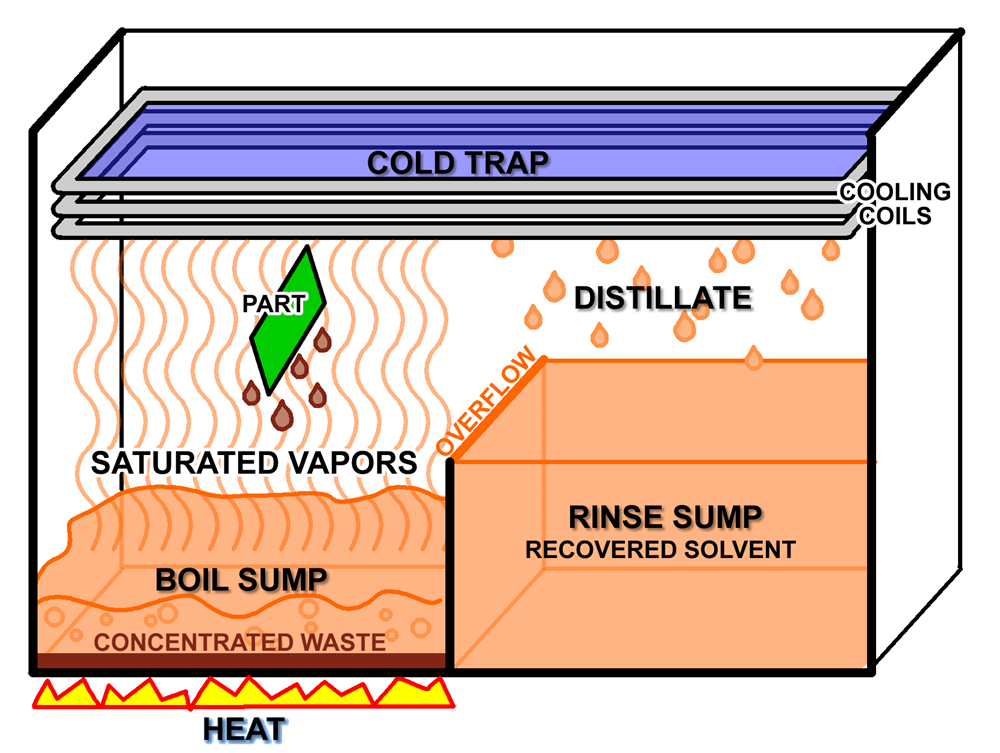
In this process, parts are placed in a metal basket that is lowered within the machine. The basket remains above the boiling solvent but below the cooling coils. The vapor degreaser boils the solvent. Solvent vapors rise but don’t escape because they’re trapped within the machine by a layer of refrigeration provided by the cooling coils.
The vapor then condenses on the surface of the parts dissolving the contaminants. As the solvent drips off the objects it removes the soils with it. This is a closed-loop process, so the solvent is cycled over-and-over again. The vapors rise into the cold trap, condense into liquid, then run back down into the rinse sump. The rinse sump then overflows into the boil sump. The soil stays in the boil sump and does not travel with the vapor, thus avoiding cross-contamination of both the parts and the rinse sump.
In Which Applications and Industries Are Vapor Degreasing Used?
In almost any industry where precision cleaning is paramount to the manufactured parts, vapor degreasing can be found. It is common in the automotive, aviation and aerospace, medical device manufacturing, jewelry manufacturing, and electronic assembly industries.
What Are the Benefits of Vapor Degreasing?
The clear benefits of vapor degreasing are superior cleaning results, repeatability, and lack of dependency on operator techniques and manual cleaning methods. The use of vaporized solvent avoids cross-contamination, which is a problem with cleaning methods that reuse either solvents or cleaning solutions from part-to-part. The use of solvents enables objects to dry quickly without a secondary drying process.
General Parts Cleaning
Our Redline parts washer uses compressed air to efficiently spray out heated fluid inside, it is good for caked on greasy parts cleaning and inside of engines before you rebuild them. We clean a lot of parts in this before we Vapor Blast or Sand blast them so we do not contaminate the media in our other machines.
More Info:
We use ultrasonic to clean carburetors after they are taken apart and ready for the rebuild. Also good for cleaning engine internals before re-assembly. It will clean out all micro passages and leave the aluminum looking like new. It will not remove any type of corrosion, vapor honing will take care of that. After Vapor Honing, we will run the carbs back through the ultrasonic to make sure all passages are clean.
We charge $20/hr with no minimum
Our Equipment:
Crest 6 gallon Ultrasonic (carbs only)
Vevor 22 Liter Ultrasonic (engine/ greasy parts)
Branson Vapor Degreaser B250
Redline - Model: RE-42HPW
Media:
Simple Green Extreme Aircraft and Precision Cleaner


